Two Sports, One Star: The Texas Athletes Rewriting the Rules of Professional Competition
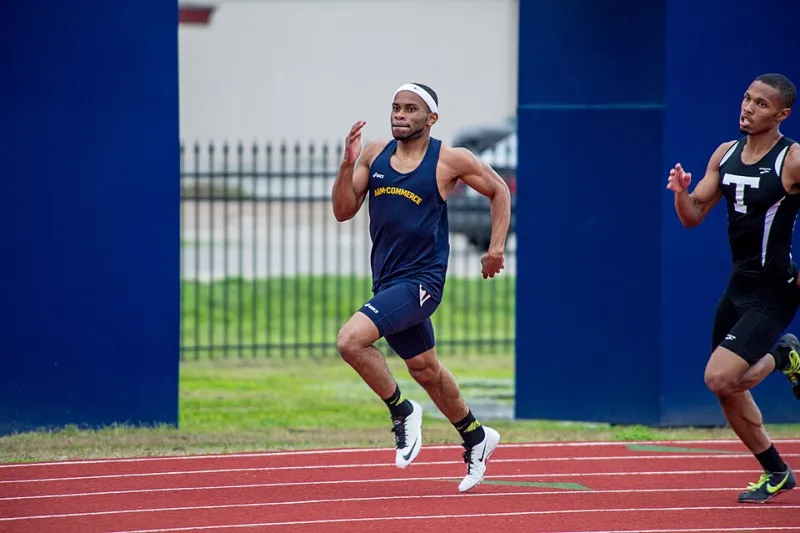
Photo: Texas A&M University-Commerce Marketing Communications Photography, CC BY 2.0, via Wikimedia Commons
There's a certain kind of athlete Texas seems to manufacture in bulk — the kind who shows up to a new sport and immediately makes everyone else look like they've been doing it wrong. You've seen it before. A kid who spent his high school years throwing touchdown passes somehow ends up on a professional baseball roster. A sprinter who terrorized UIL track meets finds herself dominating a college basketball court a year later. It's not an accident, and it's not luck. It's Texas.
Across the state, a new generation of multi-sport professionals is quietly dismantling the idea that elite athletes have to pick a lane early and stay in it forever. These crossover kings — and queens — are doing something that sports culture has long said couldn't be done at the highest level: competing in multiple professional arenas simultaneously, or pivoting between them with enough success to make scouts and coaches take serious notes.
The Texas Training Ground Nobody Talks About
Before you can understand why Texas keeps producing these athletes, you have to understand what Texas youth sports actually look like on the ground. In most states, specialization starts young — sometimes embarrassingly young. Travel baseball programs, AAU basketball circuits, and club soccer leagues demand year-round commitment from kids barely old enough to tie their own cleats. Parents get sold on the idea that narrowing focus early is the only path to a scholarship, let alone a professional contract.
Texas does things differently, and not entirely by design. The sheer size of the state means that rural programs often can't afford to let a kid sit out a season. If you're 6-foot-2 and can run a 4.5 forty, your small-town football coach isn't going to let you skip spring track. Your basketball coach isn't going to shrug when you show up for tryouts just because football season ended two weeks ago. Multi-sport participation in Texas isn't always a philosophy — sometimes it's just logistics. But the result is the same: athletes who develop a broader physical vocabulary than their single-sport counterparts elsewhere.
That broader vocabulary is exactly what makes the crossover possible at the professional level. When your body has been trained to respond to different movement patterns, different competitive pressures, and different team dynamics across multiple sports, adapting to a new professional environment isn't starting from scratch. It's translating.
Profiles in Versatility
Consider the trajectory of athletes who came up through Texas's two-a-day football culture but carried legitimate professional-level tools in a second sport. The physical demands of Texas high school football — arguably the most intense prep football environment in the country — forge a baseline athleticism that transfers. Explosiveness, pain tolerance, the ability to process a chaotic environment and make decisions in fractions of a second: these aren't football-specific skills. They're athlete skills.
Track and field has long served as the crossover pipeline in Texas. The UIL track program is one of the most competitive in the nation, and it regularly produces athletes who use it as a launching pad into professional basketball or football. The biomechanical overlap is obvious — elite sprinting mechanics translate directly to wide receiver routes and defensive back coverage. But what's less discussed is the mental overlap. Track is an individual sport wrapped inside a team framework. You perform alone, but you score for the group. That psychological duality is something multi-sport professionals describe as invaluable when they step into a new locker room.
Baseball has its own Texas crossover story. The state's warm climate means year-round development, and Texas has consistently been one of the top producers of MLB draft picks for decades. But several of those same athletes — guys with elite hand-eye coordination and the lateral quickness that comes from years of infield work — have found that their tools translate in surprising directions. The footwork required to play shortstop at a high level looks a lot like what defensive backs do in coverage. The rotational power in a baseball swing shares DNA with the mechanics of a strong forward in basketball.
What the Coaches Are Seeing
Talk to enough Texas coaches and a consistent theme emerges: the athletes who thrive in multiple sports aren't just physically gifted across the board. They're competitive learners. They get something out of being the new guy in a new sport, out of having to figure it out fast. That hunger — the willingness to be uncomfortable and unpolished in pursuit of mastery — is something Texas sports culture seems to cultivate almost by accident.
Friday night football in this state carries a weight that doesn't exist anywhere else in the country. Playing under those lights, in front of those crowds, with that level of community expectation baked into every snap — it creates athletes who are conditioned to perform under pressure before they're old enough to vote. When those athletes show up in a new professional environment, the pressure isn't new. The sport might be, but the feeling of having everything on the line absolutely isn't.
Coaches in baseball, basketball, and track have quietly started factoring Texas football experience into their evaluations of crossover athletes. It's not a formal metric, but it's real. An athlete who survived four years of Texas high school football has already been through something. That something shows up when the professional pressure gets turned up.
Is This a Trend or a Tradition?
The honest answer is probably both. Texas has always produced multi-sport athletes — the state's sports history is littered with names that appeared in box scores across multiple sports pages. What's changing is the professional landscape itself. Specialization pressure has never been higher at the youth level nationally, which means the athletes who bucked that trend and stayed multi-sport through high school and college are increasingly rare — and increasingly valuable.
In a sports world where teams are paying premium prices for athleticism that crosses traditional positional and sport boundaries, the Texas model of broad development is starting to look less like a regional quirk and more like a competitive advantage. The crossover athletes coming out of this state aren't anomalies. They're the product of a system — imperfect, unintentional in some ways, but undeniably effective — that treats athletic versatility as a feature rather than a bug.
When the next Texas kid steps onto a professional court, field, or diamond in a sport that isn't supposed to be his primary one, don't be surprised. Be impressed, sure. But don't be surprised. This is what Texas does.